


Play the Demo of Mines
Step into the game for free—play the demo now and see what it’s all about.
| What | Details |
| Game | Mines (BC Original) |
| Grid | 5×5, 25 cells total |
| Mines range | 1 to 24, player’s choice |
| RTP | 99% (house edge 1%) |
| Cashout | Anytime after first safe cell |
| Demo | Available, virtual credits |
| Provably fair | Yes, seed-based verification |
What Is Mines Game Demo
The mines demo is a free version of the same game that runs on the real-money side. The grid is the same. The multiplier math is the same. The only difference: the credits are virtual. Wins don’t pay real money. Losses don’t cost anything.
The point of a demo is practice. Understanding how the multiplier scales when five mines are on the board versus twenty. Getting a feel for how quickly things escalate at higher mine counts. Figuring out whether cashing out after three safe clicks or pushing for six feels more natural. All of this costs nothing in demo mode.
For players in India who are new to crypto casino originals, the mines game demo removes the pressure of learning with real funds at stake. The mechanics are identical. The provably fair system works the same way. The only thing missing is the financial consequence, and for a learning phase, that’s the right thing to be missing.
How Does Mines Demo Work
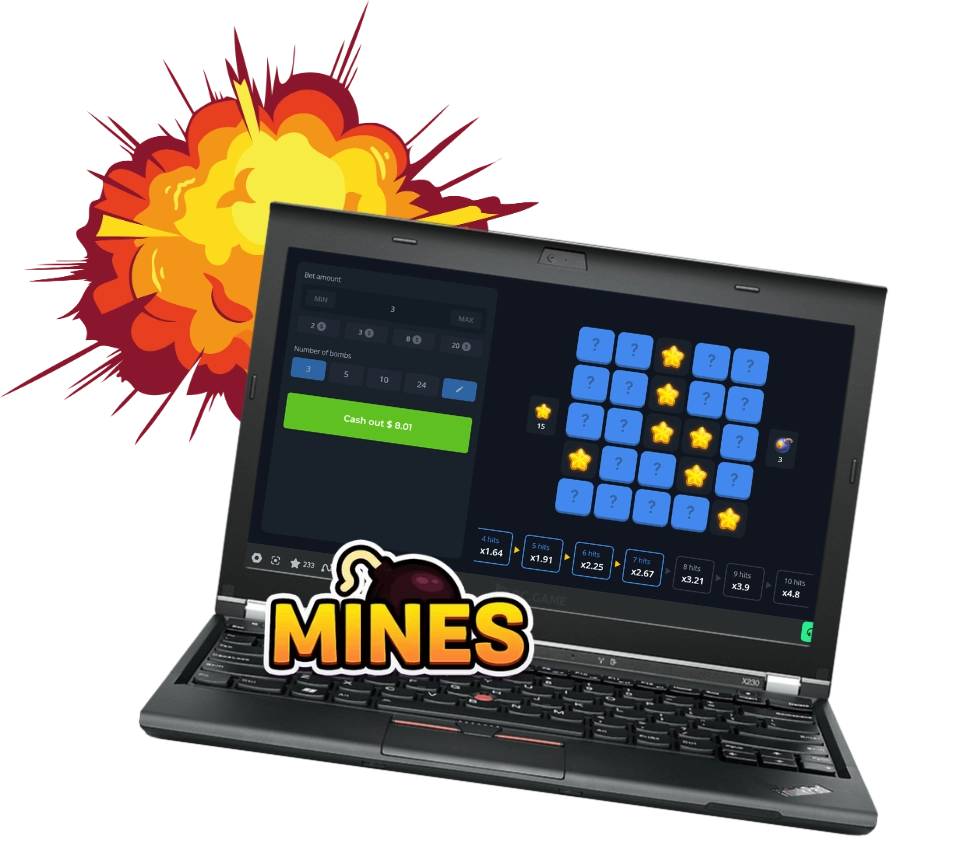
The setup screen shows two main controls. Mine count and bet size. In demo mode, the bet uses virtual credits, but the slider works the same way it does on the real side.
Pick the number of mines. Anywhere from 1 to 24. One mine on a 25-cell grid means 24 out of 25 cells are safe. The multiplier per step is tiny. Twenty-four mines means only one safe cell exists on the entire board. The multiplier for finding it is enormous, but the odds of surviving even one click are 1 in 25.
After setting the mine count, the round starts. The grid appears. Every cell is hidden. Click one. If it reveals a gem, the multiplier updates and a new, higher cashout amount appears. Click another. Multiplier climbs again. Keep going or hit the cashout button. The moment a mine is hit, the round ends. In demo, the virtual balance drops. In real play, the bet would be lost.
The multiplier calculation isn’t random. It follows probability math. Each step factors in how many safe cells remain versus how many total cells are still hidden. The platform takes its 1% edge from that calculation. The result is a multiplier that grows faster when more mines are on the board and when more cells have already been safely opened.
A practical example. Five mines on the board. First click: 24 cells remain, 20 are safe. Odds are comfortable. Multiplier barely moves above 1x. By the tenth safe click, only 15 cells remain and 5 of them are mines. The multiplier is now noticeably higher, because the risk of each click has increased. At twenty-four mines, the first click alone carries a multiplier worth hundreds of times the bet.
Key Features of the

The demo reproduces the full game without the financial layer.
The grid behaves identically. Same 5×5 layout. Same animation when a cell reveals a gem or a mine. Same multiplier display updating after each safe click. A player switching from demo to real play won’t notice any difference in how the game looks or responds.
Mine count flexibility stays the same. The full range from 1 to 24 is available in demo. Testing extreme scenarios — one mine for steady low-multiplier grinding, or twenty-plus mines for high-risk single-click attempts — costs nothing in demo mode. This is where the real learning happens. Not in reading about multipliers, but in watching how the balance moves across fifty rounds at different mine settings.
The cashout button works at any point after the first safe cell is revealed. No minimum number of clicks required. Open one cell, see the multiplier, decide whether to continue or take what’s there. The decision point is the entire game. Demo is where players can practice that decision without consequences.
Mobile works the same as desktop. The grid fits phone screens. Touch targets are large enough for thumb play. Indian users who access bc.game primarily through smartphones won’t see any compromise in the demo experience compared to desktop.
Benefits of Playing Mines Demo in India
India has a growing interest in crypto platforms, and mines game demo serves as a low-barrier entry point. No deposit. No registration required for demo in many cases. Open the page, pick a mine count, start clicking.
For Indian players specifically, a few things make the Mines demo app format useful.
Learning the multiplier math without cost. The relationship between mine count, safe clicks, and payout multiplier is not intuitive until someone plays a few dozen rounds. Reading that “more mines equals higher multipliers” is one thing. Watching a 24-mine round pay 24x on a single surviving click — and then losing ten rounds in a row trying to repeat it — teaches the lesson faster than any article can.
Testing cashout discipline. The hardest part of mines is not clicking cells. It’s stopping. The multiplier keeps climbing. One more click could double the payout. Or end the round. Demo lets players practice the stop-and-take decision in a consequence-free environment. That habit, built in demo, carries over to real play.
Understanding volatility across settings. One mine on the board plays like a slow grind. Five mines add noticeable tension. Fifteen mines turn every click into a coin flip. Twenty-four mines is almost pure lottery. Each configuration feels different, and the only way to learn which one matches a player’s appetite is to try them all. Demo makes that trial free.
The concept might remind some players of searching for gold mines in India — exploring uncertain terrain, knowing that the reward might be massive but the next step could be a dead end. Mines game captures that same dynamic in a two-minute round on a phone screen.
How to Start Playing the Mines Game Demo
The process takes less than a minute from opening the browser to the first click.
Open bc.game on any device. Navigate to the Originals section. Find Mines in the game list. The demo option is available without a funded account.
Once the game loads, the left panel shows the controls. Mine count selector at the top. Bet amount below it (virtual credits in demo). The grid sits in the center of the screen, all cells hidden, waiting for the first click.
Pick a mine count. For a first session, something in the 3–5 range is reasonable. Low enough that most clicks are safe. High enough that the multiplier actually moves. As comfort builds, higher mine counts make more sense.
Click a cell. If it’s safe, a gem appears and the multiplier updates. The cashout button now shows the current payout amount. Two choices at this point: click another cell to push the multiplier higher, or cash out and keep the virtual winnings.
The auto mode adds another layer. Players can designate which specific cells to open each round, set the number of rounds, and define stop conditions — stop on reaching a certain profit, stop on reaching a certain loss. For players testing a systematic approach across many rounds, auto mode runs the experiment faster than manual clicking.

One more feature worth knowing about. BC Game’s Originals section includes a scripting interface. Players who understand basic code can write custom betting scripts that automate mines game sessions with specific logic — fixed mine counts, cashout thresholds, bet sizing rules. The demo environment is the natural place to test those scripts before applying them with real funds.
Popular Strategies for Playing Mines
Strategy in mines is less about “winning” and more about managing the risk-reward tradeoff. The house edge is 1%. Over enough rounds, the platform takes its cut regardless. What changes with strategy is how the variance distributes — steady small returns versus occasional large ones with frequent losses in between.
- Low mine count, many clicks. With 1–3 mines on the board, most cells are safe. The multiplier per click is small. The strategy involves opening many cells per round to accumulate a modest multiplier, then cashing out. Low variance. Sessions feel steady. The downside: multipliers rarely get exciting. A round might end at 1.3x or 1.5x after ten safe clicks.
- High mine count, few clicks. With 10–20 mines, every click carries serious risk. The multiplier jumps hard after each safe reveal. Players using this approach open one or two cells and cash out if they survive. High variance. Most rounds end in a loss. The ones that survive pay enough to cover several lost rounds.
- Single-click at maximum mines. At 24 mines, only one cell on the entire board is safe. Finding it pays a massive multiplier. Missing it — which happens 24 times out of 25 on average — costs the bet. This is the highest-variance approach. It plays more like a lottery ticket than a strategy game.
- The demo is where all of these approaches get tested without financial consequence. Running fifty rounds at five mines, then fifty rounds at fifteen mines, then fifty rounds at twenty-four mines gives a visceral understanding of how each strategy feels. Numbers on a page describe the math. Playing the demo describes the experience.
- One thing that carries across all strategies: the stop decision matters more than the click decision. Choosing when to cash out, not which cell to click, is the part of mines game that separates steady players from those who burn through their balance chasing one more multiplier bump.