


The problem is structural. The mine positions in each round are generated through a cryptographic algorithm and locked before the first click. The data needed to predict the outcome sits on the game server, encrypted, inaccessible to any external tool. A mines predictor bot running on Telegram has no connection to that server. A mines predictor apk installed on a phone has no ability to read that data. A mines predictor ai claiming to detect patterns is analysing noise, because each round is mathematically independent of every round before it.
None of these tools work. Some are built by people who know they don’t work and sell them anyway. Others are built by people who genuinely misunderstand the game’s architecture. The outcome for the player is the same either way.
What Is a Mines Bot Predictor?
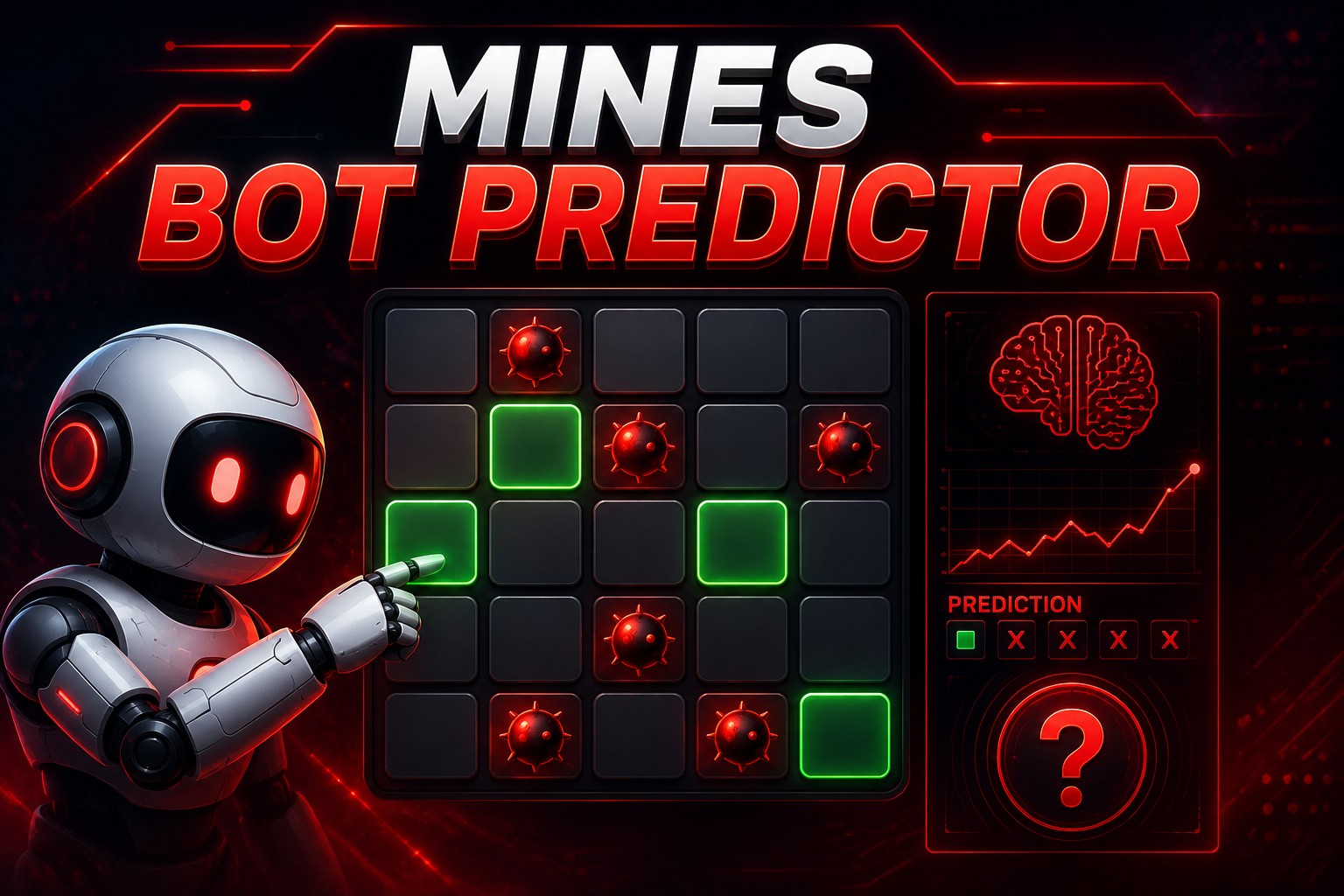
Any tool that claims to predict mine locations in the Spribe Mines game falls under this label. The specific formats vary.
Telegram bots are the most common. A channel posts a 5×5 grid image before each round. Stars mark the “safe” cells. Crosses mark the “danger” cells. The player follows the instruction, clicks the marked cells, and either wins or loses. Winning rounds get screenshotted and posted as proof. Losing rounds get deleted or blamed on timing.
Signal websites work similarly. A page updates with a predicted grid every few seconds. The player copies the pattern into their game session. The website collects traffic and runs ads. Some ask for casino login credentials “to sync the predictions.” That request is the actual product — the site harvests passwords.
Browser extensions claim to read the casino page’s code and overlay coloured markers on the grid. Green for safe. Red for mine. The extension charges a subscription or routes the player through an affiliate link. The markers are generated without any connection to the actual mine placement algorithm.
Mines predictor apk mod files go further. A modified APK that supposedly includes prediction capabilities built into the casino app itself. The modification may include the base casino interface plus added code that has nothing to do with prediction and everything to do with capturing keystrokes, clipboard contents, or screen data.
How Mines Game Generates Results

The prediction tools fail because they promise access to information that’s locked behind cryptography. Here’s what actually happens inside the game.
Before each round starts, the server generates the complete mine layout. Every position on the 5×5 grid is assigned — mine or gem — before the player clicks anything. The server creates a seed, processes it through HMAC_SHA256 (a cryptographic hashing function), and shows the player only the hash. The hash is a one-way function. Seeing it tells the player nothing about the seed behind it.
The player’s browser contributes a client seed. The server combines the server seed, the client seed, and a nonce (the round number) to produce the final mine placement. This happens once, before the round begins.
After the round ends, the server reveals the original seed. The player can take all three values — server seed, client seed, nonce — run them through the same algorithm, and verify that the mine positions match what was played. The system is called provably fair because the proof is available to anyone who wants to check.
Two facts matter for the predictor question. First: the server seed is encrypted before the round starts and cannot be read by anything outside the server until the round ends. Second: each round uses a fresh combination of seeds and nonce. Round 50 has no mathematical relationship to round 49. Patterns observed across previous rounds carry zero predictive value for the next one.
How Predictor Bots Claim to Work
The marketing language varies. The core claims fall into a few categories.
“AI pattern analysis.” The bot supposedly analyses thousands of previous rounds and detects patterns in mine placement. Since each round is cryptographically independent, no pattern exists to detect. The AI is analysing random data and finding coincidences that have no predictive power.
“Server scanning.” The bot claims to connect directly to the game server and read the mine positions before the round starts. The server seed is encrypted. The connection between the player’s device and the server is secured with HTTPS. No Telegram bot has credentials to access the game’s backend. The claim is equivalent to saying “our bot reads your bank’s database.”
“Algorithm cracking.” The bot claims to have reverse-engineered the provably fair algorithm. The algorithm is public — Spribe publishes how it works. Knowing the algorithm doesn’t help. The unpredictable element is the server seed, which is new for each round and encrypted until the round ends. Cracking the encryption in real time would require breaking SHA256, which no consumer-grade tool can do.
“95% accuracy signals.” The bot posts predictions and claims a 95% hit rate. The hit rate is manufactured. Correct predictions get posted publicly. Incorrect ones get deleted, edited, or attributed to “server lag.” A bot making random guesses on a low-mine-count grid will occasionally match the actual layout by pure chance. Those matches become the marketing material. The misses disappear.
Why Mines Predictor Bots Cannot Work
Three independent reasons. Each one is enough on its own.
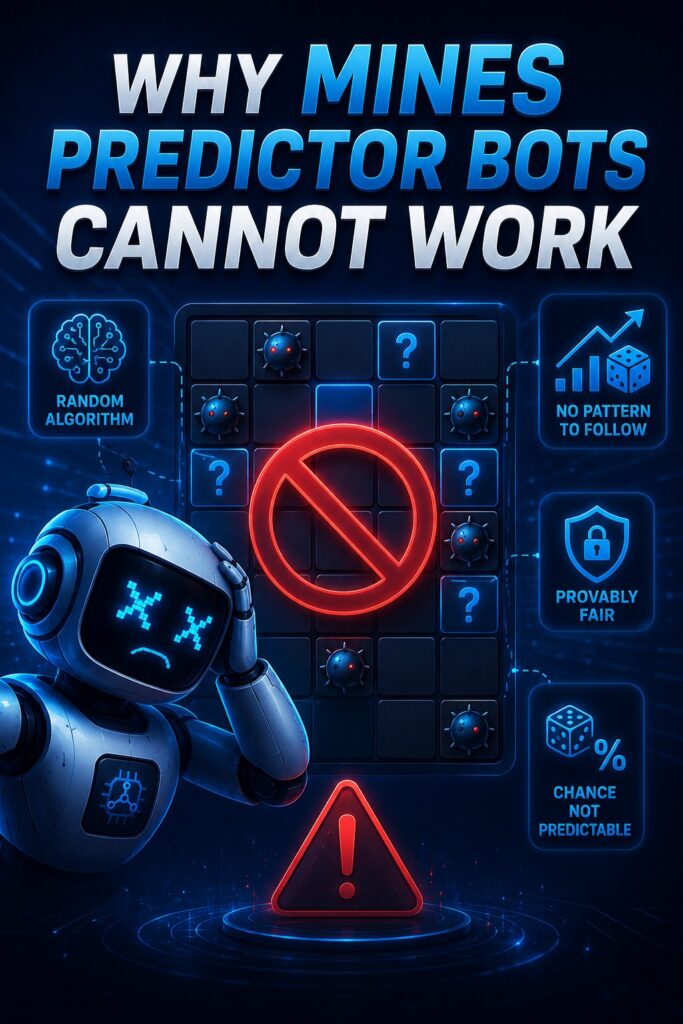
The mine positions are encrypted. The server seed that determines where mines go is hashed before the round starts. No external tool can read the seed through its hash. The encryption is the same class of cryptography that protects banking systems and encrypted messaging apps. If a Telegram bot could crack it, the implications would extend far beyond casino games.
No external tool connects to the game server. The mines predictor bot runs on its own infrastructure. It has no API access to Spribe’s systems. No authentication credentials. No data pipeline from the game backend. The bot cannot see what it claims to predict because there is no channel between it and the data.
Rounds are independent. Even if a tool could analyse previous rounds perfectly, the analysis would produce nothing useful. Round N+1 is generated from a new server seed, a new nonce, and the same client seed. The output has no dependency on round N. Looking for patterns across rounds is looking for structure in structureless data.
A mines hack predictor that claims to bypass all three of these barriers is claiming to have broken modern cryptography, infiltrated a secured server, and found patterns in mathematically independent events. Simultaneously. For a subscription fee.
Common Mines Predictor Scams
The predictor space runs on a few repeating business models.
- Paid VIP access. A free Telegram channel posts occasional “signals.” Some happen to match the actual mine layout by chance. The channel owner screenshots those, posts them as proof, and offers paid access to a “VIP channel with 99% accuracy.” The VIP channel runs the same random guesses as the free one. The subscription fee is the product.
- Referral traps. A bot offers free predictions but requires the player to register at a specific casino through an affiliate link and make a deposit before the signals start. The bot operator earns a commission on the player’s losses through the casino’s affiliate program. The “free” predictions cost the player their deposit. The bot operator profits whether the predictions work or not — and they don’t.
- Predictor APK sales. A modified app sold for cash or crypto. The buyer installs it expecting prediction capabilities. What they get varies: sometimes a cosmetic overlay that generates random grids, sometimes a functional casino app with added malware, sometimes an app that crashes on launch and the seller stops responding.
- Courses and strategy groups. Not tools, but communities that sell access to “prediction methods” for a flat fee. The method usually turns out to be a betting progression (double after a loss, reduce after a win) dressed up with screenshots and testimonials. The math behind these progressions doesn’t overcome the house edge. The course fee is a definite loss before any game is played.
Risks of Using Predictor APKs
Installing a mines predictor apk from an unverified source introduces risks that go beyond losing a bet.
Credential theft. The APK includes a login screen that mimics the real casino interface. The player enters their username and password. The data goes to the APK creator. The casino account gets emptied before the player realises what happened.
Clipboard hijacking. The APK monitors the clipboard for cryptocurrency wallet addresses. When the player copies an address for a deposit, the APK swaps it with the attacker’s address. The deposit goes to the wrong wallet. Crypto transactions are irreversible.
Keylogging. The APK records keystrokes in the background. Every password typed on the device — email, banking, social media — gets captured and sent to the attacker.
Account bans. Casino platforms monitor for third-party software interacting with their games. Browser extensions that overlay elements on the grid or inject scripts can trigger fraud detection. The consequence is account suspension, sometimes with balances frozen.
The risks of a mines predictor apk mod are the same, plus the additional uncertainty of running modified software where the modifications are invisible to the user.
Why Players Believe in Mines Predictors
The belief makes psychological sense even when the logic doesn’t hold up.
- Apophenia — seeing patterns in random data. Three rounds in a row with mines in the corners. The brain says “mines cluster in corners.” The cryptographic generator has no concept of corners. But the brain evolved to find patterns. It’s good at it. Too good, sometimes, finding structure where none exists.
- Tilt. After a streak of losses, frustration builds. Critical thinking drops. The offer of a tool that “solves” the problem feels like relief. The angrier the player, the less scrutiny the tool receives. Scam operators know this and specifically target players after losing streaks.
- Survivorship bias. The Telegram channel posts ten predictions. Three match. Those three get highlighted. The seven misses vanish. New users see a curated record of successes. The full record — including all the failures — is never shown.
- Illusion of control. Clicking a cell that a “bot recommended” feels more controlled than clicking randomly. The outcome is identical. The psychological comfort is real. The mathematical advantage is not.
Realistic Approaches to Mines
Legitimate play doesn’t involve prediction tools. It involves decisions about risk, bet sizing, and when to stop.
- Bankroll management. Bet 1-5% of the session budget per round. A bad streak doesn’t wipe the balance in three rounds. The session survives long enough for variance to play out.
- Conservative cashout. Setting a target multiplier — 1.2x to 1.5x — on a low mine count and taking the money as soon as that target hits. Small wins. Frequent. The balance moves slowly upward between the rounds that end in a mine.
- Mine count selection. Fewer mines means safer clicks but slower multiplier growth. More mines means faster growth but higher loss frequency. The choice depends on the session goal and the bankroll size. Demo mode is the right place to test different settings.
- None of this removes the house edge. The platform keeps its percentage over time regardless of strategy. What changes is the shape of the session — steady and gradual versus volatile and unpredictable.
Predictor Bots vs Real Gameplay
| Aspect | Predictor Bots | Real Risk Management |
| Promise | 90-100% accuracy, guaranteed income | No guarantees, controlled losses |
| Data access | Claims server access (false) | Uses public probability math |
| Cost | Subscriptions, APK purchases, affiliate deposits | Free (just player decisions) |
| Risk to device | Malware, keyloggers, clipboard hijackers | None |
| Risk to account | Bans for third-party tool use | Fully permitted |
| Risk to data | Credential theft, screen capture | None |
| Effectiveness | Zero | Marginal edge through variance control |
How to Avoid Fake Mines Predictors
Three rules cover most of the ground.
Don’t download APK files from sources other than the casino operator’s official site. A mines predictor apk from a Telegram channel, a YouTube description, or a search result page is unverified software. The risk is not theoretical.
Don’t pay for signals. If someone had genuinely found a way to predict cryptographically generated random outcomes, they would be quietly extracting millions from casino platforms. They would not be selling Telegram subscriptions for ten dollars a month. The business model contradicts the claim.
Don’t enter casino login credentials, wallet seed phrases, or personal data into any third-party tool. No legitimate prediction tool exists, so any tool asking for this data is collecting it for other purposes.